
Word: Ayu Arman
The Karapao rite is not just an initiation rite, from child
to adult, but also the Kamoro, Papua, Indonesia tribe’s way of understanding and addressing the cycle of life. In this rite, you are shown how the Kamoro view the visible and invisible worlds simultaneously in an intimate and wise cultural attraction.
Karapao is the traditional coming-of-age ceremony of Kamoro boys, also known as initiation. At this moment, the ancestors bless the children to become more mature and independent as individuals and citizens of the Kamoro tribe.
Traditionally, a Kamoro boy undergoes initiation through three stages. The first stage is at the age of seven or eight, and the second at the age of fifteen or sixteen. This second ceremony, where he exchanges his tapena, a type of child’s penis-covering garment, for a tasselled skirt marks the transition to manhood.
The third stage is an additional stage when the boy is fully grown and ready for marriage. At this stage, the traditional leader will pierce the boy’s nose by inserting a boar tusk through the septum. This is a bloody and painful procedure and in the past, infections and other complications were so common that nose piercing has become a rarity.
Today, there is only one stage of the Karapao rite, which is when the boy is about ten years old.
When Kamoro children are about ten years old or older, and they are ready to perform the traditional Karapao ritual, the elders gather to deliberate on the timing.
The exact time is determined by the village elders according to traditional calculations. Over time, the Karapao rite has also taken into consideration the Indonesian school holiday calendar and public holidays.
If the kakuru or the person with the honour permits, preparations begin with the building of the karapauw kame and mbitoro poles. Meanwhile, the villagers collect large quantities of sago, the women fish, and the men, with their best dogs, hunt wild boar in preparation for the food.
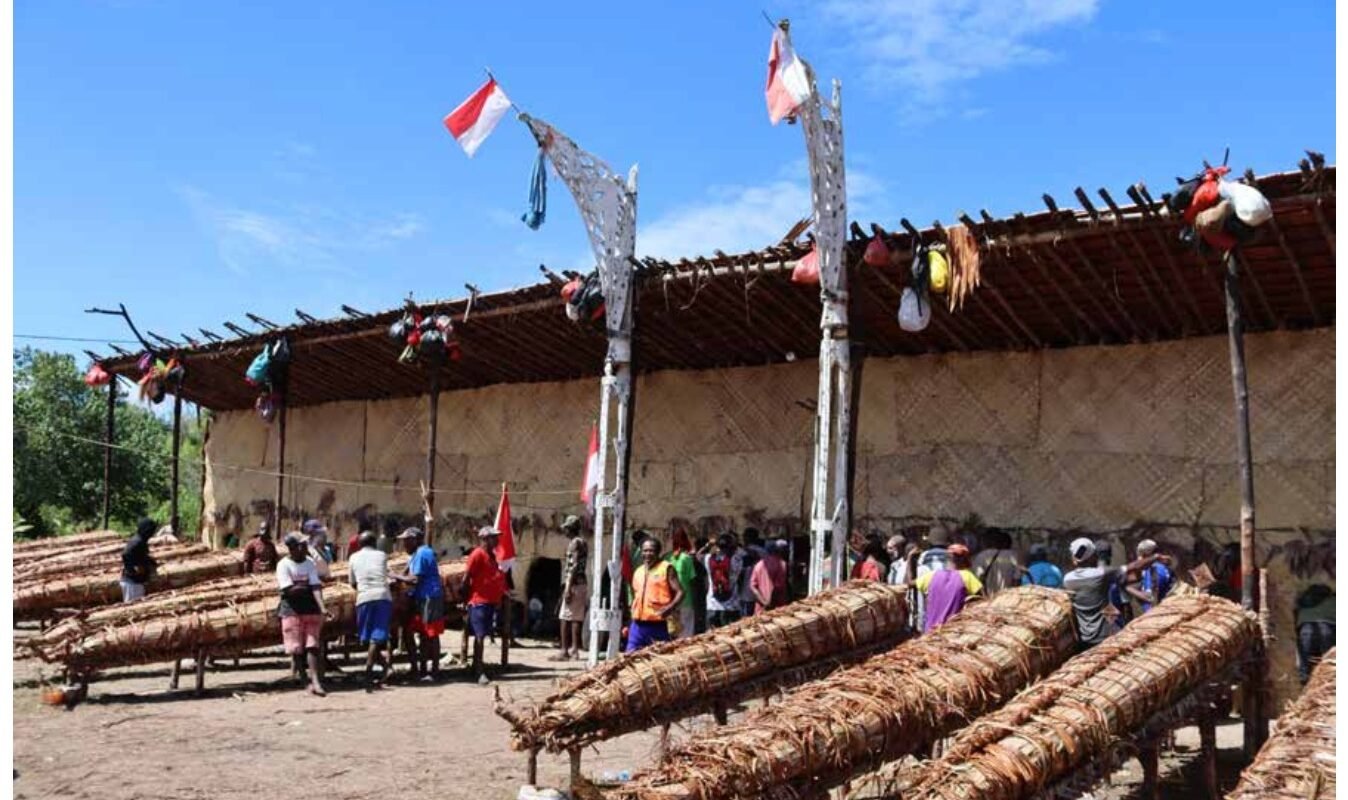
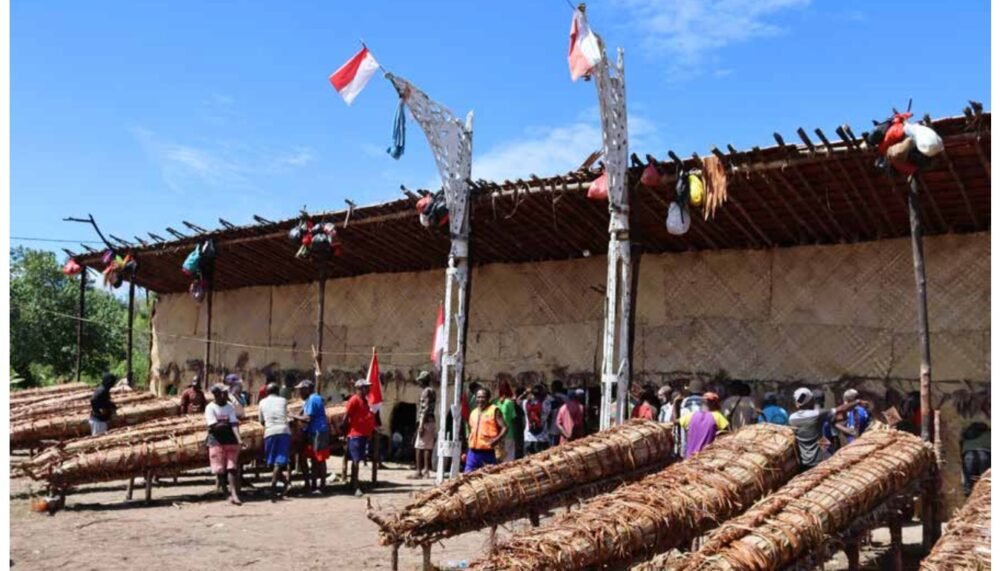
To build a karapauw kame, it usually takes about six months, if not longer. The karapauw kame is a temporary, rectangular traditional house with no partitions framed by tied poles, walls made of woven leaves and a thatched roof arranged in a single flat plane. The width of the karapauw is about three metres, the length depends on the number of ‘doors’, and the number of doors depends on the number of boys to be initiated.
The karapauw kame is built facing west because they believe that all deceased ancestors will leave and settle when the sun sets to the west. Each karapauw must have an mbitoro in front of it, a wooden statue decorated with various ornaments symbolising nature and living things.
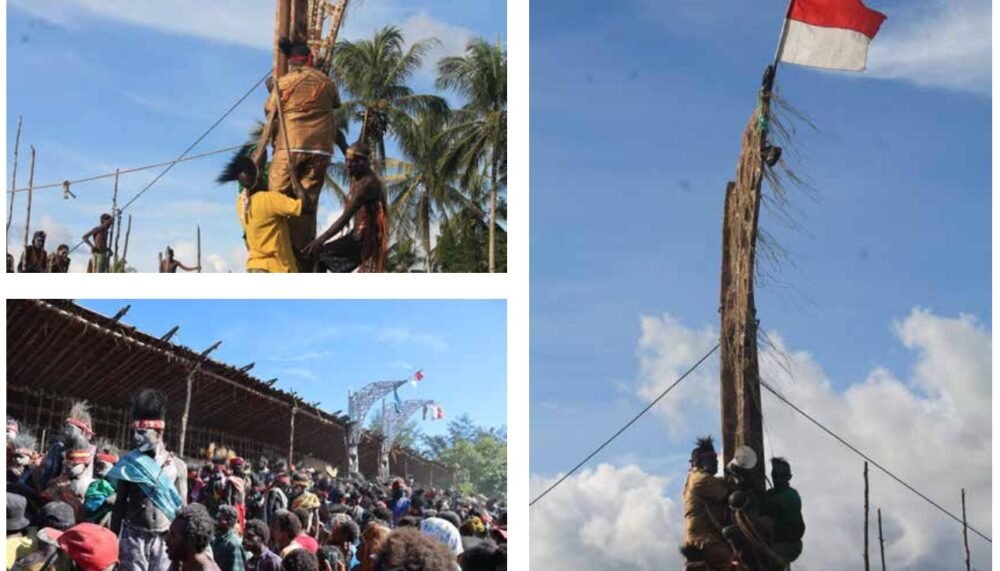
Before the pole is planted in front of the traditional house, the founders dig a hole at night. The hole is like an entrance to the underworld. In the morning, the children to be initiated are brought to the hole and then the mbitoro pole is paraded around the village before being erected in front of the traditional house.
All villagers gather in front of the traditional house. Opakawe leads the entire procession, from death to resurrection. Mbitoro spells are recited to awaken and bring the ancestors to fill the mbitoro poles.
The poles are then driven into the ground and dozens of arms push them upwards. Within seconds, the poles are upright, tied to the karapauw frame, and the sand at the base is firmly compacted. Its wings dangle upward as if waving to the sky and its feet descend to embrace the world below.
The mbitoro in this ritual serves to restore the spiritual power and wisdom of the deceased community member, who was someone strong, and respected during his or her lifetime, who should be a role model for the initiated youth.
With the embedding of the mbitoro, the traditional house of karapauw kame has been completed: the middle world (earth), the upper world, and the lower world.
Karapao is held over several days, similar to a carnival. Tifa are beaten, dances are performed, and chants led by ndikiarawe echo throughout the ceremony.
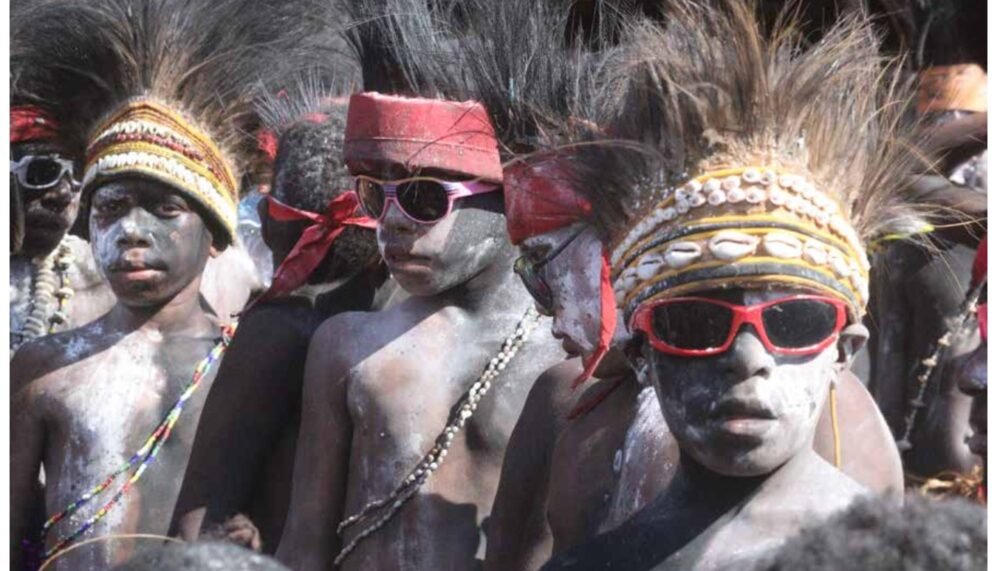
The bodies of initiated children are painted by older brothers and other brothers with a variety of striking motifs. Their bodies are fully painted with soot and lime, decorated with rosettes produced by the easily moulded seed caps of bruguiera trees, and accented with bright orange or red ochre from annatto seeds.
The pattern is not random, serving as a symbol to represent the boy’s tapar. The final touches are wildly patterned pieces of cloth, a strange hat-anything from a Muslim peci to a baseball cap with rabbit ears-and a new pair of sunglasses and are then carried out of the traditional house area. .
The dancing and drumming continues, moving the bodies of all the people watching, welcoming the children who have been initiated into adulthood.
The final stage of Karapao is the distribution of sago and pork to one- generation groups or close relatives. The purpose of this stage is to regenerate kinship within the community.
The Karapao rite is also a time to eat together with the whole village. Delicious meals of sago, fish and pork are cooked over a campfire. This final stage of Karapao lasts several days, and during this period spirits rise and stomachs are full.
The nightly dancing and drumming will continue for several days before the first stage of Karapao actually ends. Then, the building will be quiet for six months or even a year, until it is time to put up the walls and paint the boys for initiation. It is exactly at that point that the initiation cycle is truly complete.
Before a year has passed, the mbitoro will look like it is a hundred years old. Heavy rains quickly erase its colour, leaving behind the glare of the equatorial sun that bleaches its wood to a dry, cracked grey.
At the right time, the carvings will be burned with wisdom and the ashes will be scattered.**